There are countries that market themselves well. And there are countries that, in addition to marketing themselves well, truly transform themselves. Thailand belongs to that second category. For years, it was known for its hospitality, its appeal to tourists, and a nightlife that seemed to speak directly to those seeking freedom, anonymity, or simply a place to be without having to explain themselves too much.
But in 2026, the conversation has changed. The country can no longer be described simply as an “LGBTQ+-friendly” destination. That label no longer does it justice. Today, Thailand is one of the most progressive countries in Asia when it comes to inclusion, with a legal framework that supports what was once merely a cultural perception.
The enactment of the Marriage Equality Act in January 2025 made the country the first in Southeast Asia to legally recognize same-sex marriage and marked a turning point for the region.
We’re not talking about a well-crafted campaign or a tourism slogan. We’re talking about civil rights, family recognition, inheritance, medical decisions, joint adoption, and a transformation that is finally taking root in the daily lives of thousands of couples.
The reform replaced the exclusionary language of the past with a neutral definition of marriage and granted same-sex couples the same legal status as heterosexual couples under the law. In concrete terms, this means that the country has moved from social acceptance to legal protection. And for those who travel, live, or love in this context, that difference is significant.
You might also be interested in reading: Traveling Alone in Thailand: A Safer Experience Than You Might Think.
A country that changed faster than its own postcard
For a long time, Thailand was known as an exception on an Asian map that remained uneven when it came to LGBTQ+ rights. The idea that it was “open,” “relaxed,” and “friendly” was often repeated, and while there was some truth to that description, it also left out an essential part of the story: social acceptance had not always been accompanied by legal recognition.
The tourism narrative, on its own, was not enough. What happened between 2024 and 2026 was precisely the process of bridging that gap between image and reality.
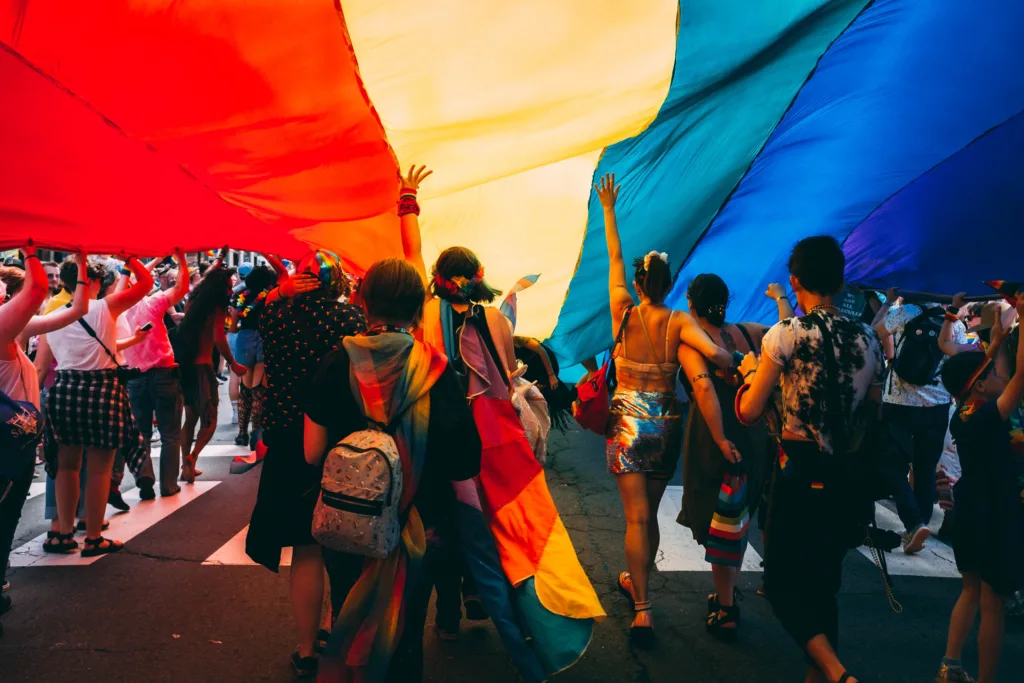
The legalization of same-sex marriage did not come out of nowhere. It was the result of years of activism, political debate, and sustained social pressure that culminated in a law. In 2025, Thailand passed a historic reform and sent an international message of institutional openness. It is no longer just a country with LGBTQ+-friendly neighborhoods or a diverse nightlife scene, but a nation that has begun to translate that diversity into concrete rights.
The magnitude of the change is also reflected in the figures. In the first year the law was in effect, thousands of couples formalized their unions, and by January 2026, the country had recorded more than 26,000 same-sex marriages. This figure not only illustrates the scope of the reform but also demonstrates that there was a real, silent, and long-suppressed demand for legislation that would finally recognize it.
The Cultural Significance of Gender Identities in Thailand
Any text on Thailand and sexual diversity must carefully address the issue of gender identities. For years, the Western imagination oversimplified this conversation by using terms such as “ladyboys” or, to a lesser extent, “kathoey,” as if they were fixed categories equivalent to contemporary notions of trans identity. The reality is more complex.
In Thailand, the term “kathoey” is part of the country’s cultural history, but the current discourse is shifting toward language that is more precise and aligned with international human rights standards.
More and more people, especially among younger generations and activists, prefer to refer to trans women, trans men, and nonbinary people. This change—which may seem purely linguistic—is a sign of political and cultural maturity. Identity is no longer treated as an exotic spectacle but is now recognized as a matter of dignity, citizenship, and representation.
Thailand has always had a highly visible presence of transgender people in public life, entertainment, fashion, and beauty pageants. But the current context calls for a deeper understanding of that visibility. It is no longer enough simply to note that representation exists.
We must also ask ourselves what rights underpin it and how far the country is from resolving outstanding issues, such as the legal recognition of gender in official documents. The answer is clear: the country has made significant progress, but the journey is not over.
A country that rewrites its own history
Ultimately, Thailand’s true beauty lies not only in the majesty of its landscapes, but also in its ability to rewrite its own narrative. It is a country that has come to understand that tradition and progress need not be opposing forces, but rather the foundations of a more just society.
For those of us looking toward Southeast Asia, this progress teaches us a clear lesson: structural change is possible. And although debates surrounding identity and equity continue, the ground we stand on today is no longer that of mere tolerance, but rather that of the demand for full rights.
This new landscape completely transforms the way we understand, inhabit, and travel through the country. Because once the laws change, inclusion moves beyond the courts and spills out into the streets, into pop culture, and into the way the country welcomes the world. And it is precisely there—in the daily pulse of its cities—that this new reality comes to life. But that, of course, is a story we’ll explore in our next reading.